28 Oct
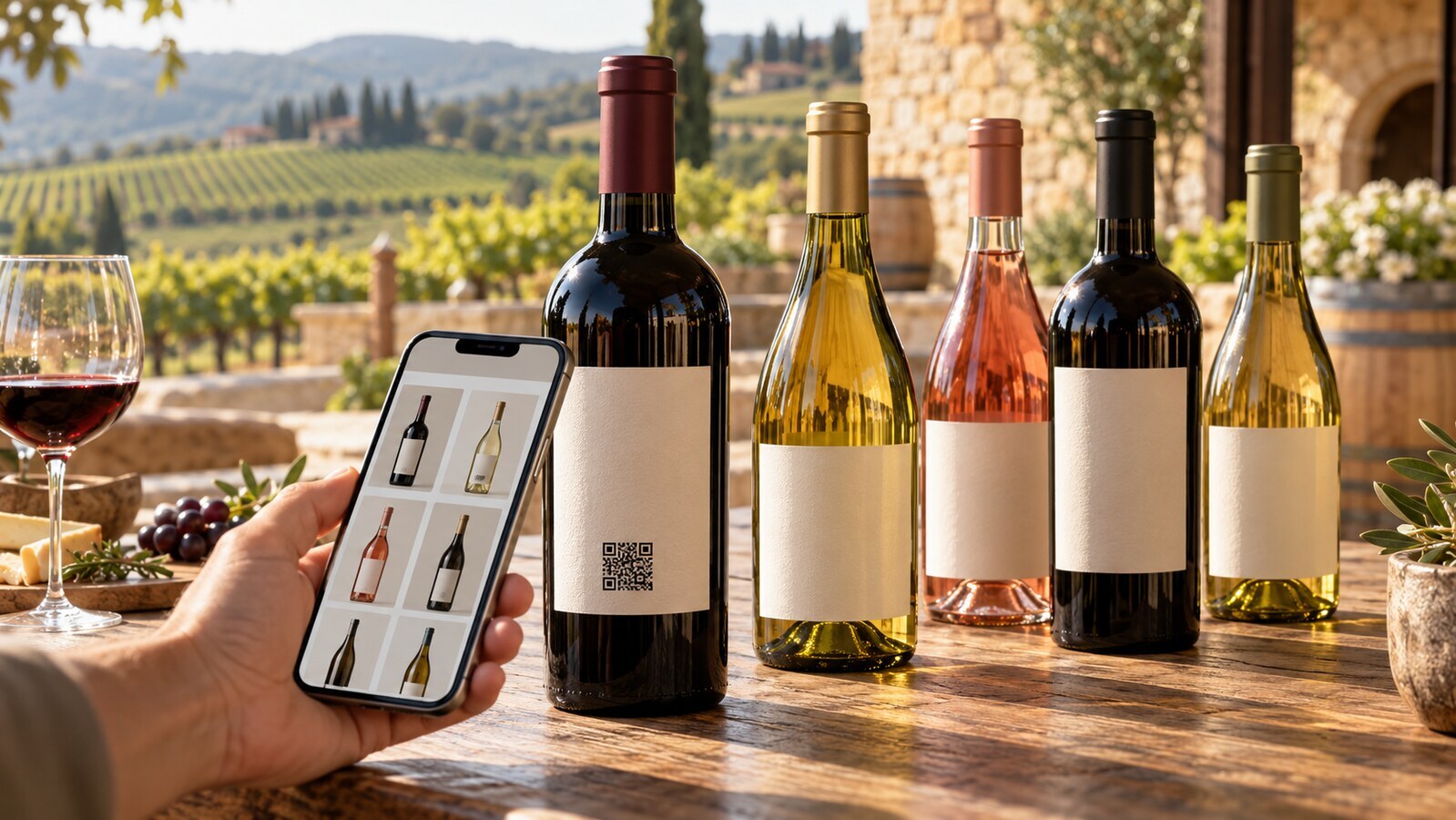
The problem: one wine, one link, too many links
If you sell ten wines, you have ten e-label pages and, usually, ten QR codes. That's fine on the bottle itself: each wine needs its own compliant page. But when you want to send a buyer, an importer or a journalist a single link to your whole range, ten separate links is clumsy. A catalog page solves that specific problem: it is a web page where you group several of your products together and share them as one link.
This is a presentation feature, not a replacement for the mandatory e-label. The two should stay separate in your mind and in how you use them.
What a catalog page is for
A catalog page in EU-Label lets you:
- Select multiple products already set up in your account.
- Generate a single web page listing those products together.
- Share one catalog link instead of sending individual product links one by one.
- Use it as a simple public portfolio: for a trade fair, a distributor pitch, or your own website.
It's useful whenever someone needs an overview rather than a single wine's compliance information: a new importer asking "what do you produce", an agency preparing a listing, a retailer deciding which wines to carry.
What a catalog page is not
This is the part worth being precise about, because EU wine law draws a hard line here.
Under Article 119 of Regulation (EU) No 1308/2013, when the ingredient list and/or full nutrition declaration are provided electronically, that electronic page:
- must not display information intended for sales or marketing purposes, and
- must not collect or track user data.
That restriction applies to the mandatory e-label page: the one linked from the QR code on the bottle that carries the ingredient list and nutrition declaration. It is a compliance page, not a sales page, and it has to stay that way.
A catalog page is a different, separate page. It's where portfolio and sales-oriented presentation belongs, precisely because the mandatory disclosure page cannot carry that kind of content. Keep the two apart:
- E-label page (per product): ingredient list and/or nutrition declaration, provided under Article 119 conditions. No marketing, no tracking.
- Catalog page (across products): your portfolio, grouped and shared as one link, for people who want an overview rather than one wine's compliance data.
Required allergen information always stays on the physical label regardless of which electronic pages exist, since Article 119 keeps allergen particulars on the package itself when the ingredient list is provided electronically.
Setting one up
In an EU-Label account, building a catalog page is a short, additional step once your individual product pages already exist:
- Make sure the wines you want to include already have their own e-label pages set up in your account (product data entered manually, via smart forms, or imported from Excel).
- Open the catalog page section and select which products to include.
- Generate the catalog page. You get one shareable link covering all the selected products.
- Share that link wherever an overview is more useful than a single-product link: on your own site, in an email to a buyer, in a printed sheet, or at a fair.
Because it draws on products already set up in your account, there's no second round of data entry. If a wine's e-label page changes later, the catalog page reflects the current list of products you've chosen to include.
Where this fits for small producers
If you make three or four wines, a catalog page might just be a convenience: one link instead of three. If you run a cooperative or a larger portfolio, it becomes more practical: a single page you can point an importer to instead of managing a list of individual QR links by hand.
It's also a reasonable thing to prepare ahead of trade fair season. If you're heading to Wine Paris, ProWein or Vinitaly, having one catalog link ready to hand out or put on a stand sign is simpler than juggling a QR code per bottle on the table.
What EU-Label provides, and what stays your responsibility
EU-Label provides the catalog-page feature as part of every subscription, along with the individual e-label pages, GS1 Digital Link-compatible QR codes, and the reusable product-data structure that feeds both. New labels are priced per year, from €4.00 down to €1.50 per label depending on volume, with unlimited scans and free edits included; these are final prices with no VAT added. Catalog pages draw on products you've already created, so they don't add to that per-label count on their own.
What stays your responsibility is making sure each individual wine's e-label page respects the Article 119 conditions: no marketing mixed into the mandatory ingredient or nutrition content, and no tracking on that page. The catalog page is where you're free to present your range however you like; the per-product e-label page is where the legal restrictions apply.
Next step
If you're setting up e-labels for several wines and want one link to share the whole range, create your products and a catalog page in EU-Label. If you're not sure where the line falls between your mandatory e-label content and what you can put on a catalog or portfolio page, write to contact@eu-label.info and ask before you publish.



 EN
 RO
 FR
 IT
 ES
 DE
 HU
 SK
 CS