18 Nov
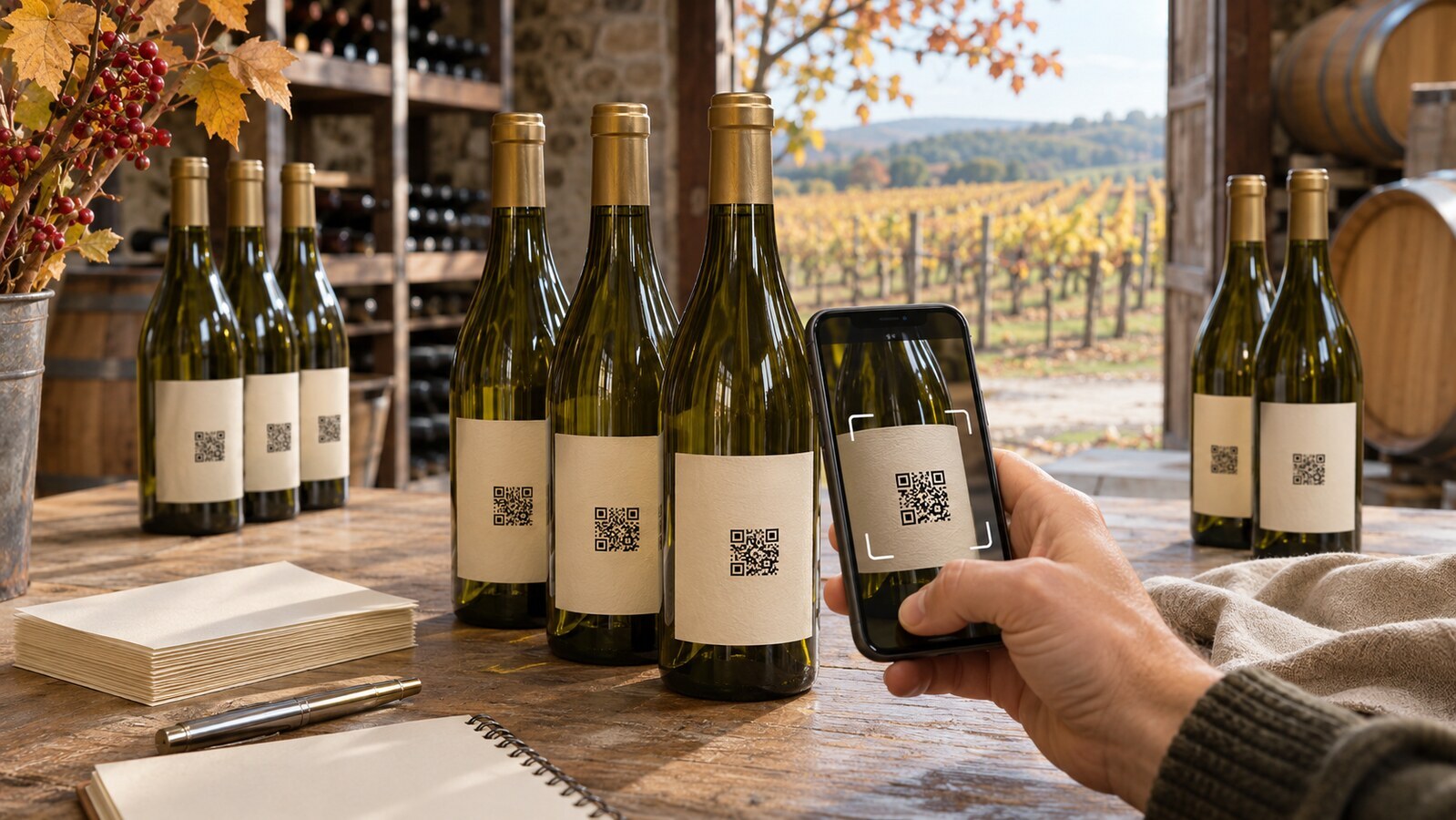
November and December are when most wineries finish bottling the new vintage and start thinking about next year's budget. That makes it the right moment to count how many new e-labels you'll actually need in 2027, because EU-Label's pricing is based on new labels created per subscription year, not on how many bottles you sell or how many times a QR code gets scanned.
Why count now
If you wait until January to think about labels, you're often deciding under pressure, with a shipment date already set. Counting now, while the new vintage is still being labelled, gives you time to:
- Check how many distinct wines (not bottles) you bottled this year.
- See which of them are genuinely new products versus a repeat of last year's wine with the same data.
- Decide if any wines will be discontinued, merged, or renamed for 2027.
- Compare that number against the pricing tier you're currently on.
A "new label" in EU-Label's pricing means a new digital label or QR code created during the subscription year, not a reprint of the same product information. If a wine's data doesn't change, it keeps running on the label you already created; you don't pay for it again.
How the pricing actually works
EU-Label charges per new label created in a subscription year, with the price per label dropping as volume goes up:
- 1–39 new labels: €4.00 per label (up to roughly €156 a year)
- 40–99 new labels: €3.75 per label (from roughly €150)
- 100–149 new labels: €2.50 per label (from roughly €250)
- 150–399 new labels: €2.00 per label (from roughly €300)
- 400 or more new labels: €1.50 per label (from roughly €600)
These are final prices with no VAT added. A few things matter when you're estimating your own cost:
- Labels already created stay active for as long as the subscription is active. You don't pay again for a label just because a previous vintage is still being sold.
- Unused label allowance doesn't roll over. If your tier gives you room for 100 labels and you only create 60 this year, the other 40 don't carry into next year.
- Scans are unlimited and don't add cost. Whether a label is scanned ten times or ten thousand times, the price per label is fixed by how many new labels you create, not by traffic.
- Edits to existing labels are free. Correcting a vintage year, an alcohol percentage, or an ingredient entry on a label you already created doesn't count as a new label and doesn't cost extra.
What counts as "new" for next year
This is the part that trips people up at year-end planning time. A new label is typically needed when:
- You bottle a wine under a new product name or new SKU.
- A wine moves to a new vintage with data that changes enough that you want a separate label page for it (rather than updating the existing one).
- You add a wine to your portfolio that didn't have a digital label before.
A new label usually is not needed when:
- The same wine, same vintage, same data is simply being re-shipped or re-labelled physically with the same QR code.
- You're correcting a typo or updating an ingredient note on an existing label.
- You're reusing last year's product data to speed up entry for a new vintage; reuse of data is separate from whether the label itself counts as new, and it's worth reviewing case by case if you're unsure.
Matching your count to a tier
Once you have a rough number, for example "we expect to bottle 18 wines next year, 5 are brand new," you can map that against the tiers above. A few practical points:
- If your count sits close to a tier boundary (39 vs. 40, 99 vs. 100), it's worth checking whether a slightly larger order this year brings a meaningfully lower per-label price overall.
- Cooperatives and larger portfolios with several producers under one account often land naturally in the higher tiers, where the per-label price is lowest.
- Small producers with a handful of wines and infrequent new releases will usually sit in the 1–39 tier, and that's fine: there's no minimum commitment beyond what you actually create.
Where EU-Label fits into this planning
EU-Label is built so that counting labels is something you can actually do with confidence: each label corresponds to one product page and one QR code, your account shows what you've created, and reused product data (company details, producer information, repeated ingredient entries) doesn't force you to recreate a label from scratch. Support is available through chat, WhatsApp, email, documentation, and video onboarding if you want to talk through your count before committing to a tier for 2027.
What EU-Label does not do is guess your volume for you or lock you into a number. You pay for the new labels you create in the year, at the rate that matches your actual volume, and the allowance resets at renewal.
Getting your count done
Before the year closes, pull together a simple list: wines bottled this year, wines planned for next year, which ones are genuinely new versus continuations. That one list is most of what you need to pick a pricing tier with confidence.
If you want help thinking through the count, or you want to see how label creation and reuse work in practice, start at eu-label.info or write to contact@eu-label.info with your rough numbers and we'll help you figure out where you land.



 EN
 RO
 FR
 IT
 ES
 DE
 HU
 SK
 CS