04 nov.
Răspunsul scurt
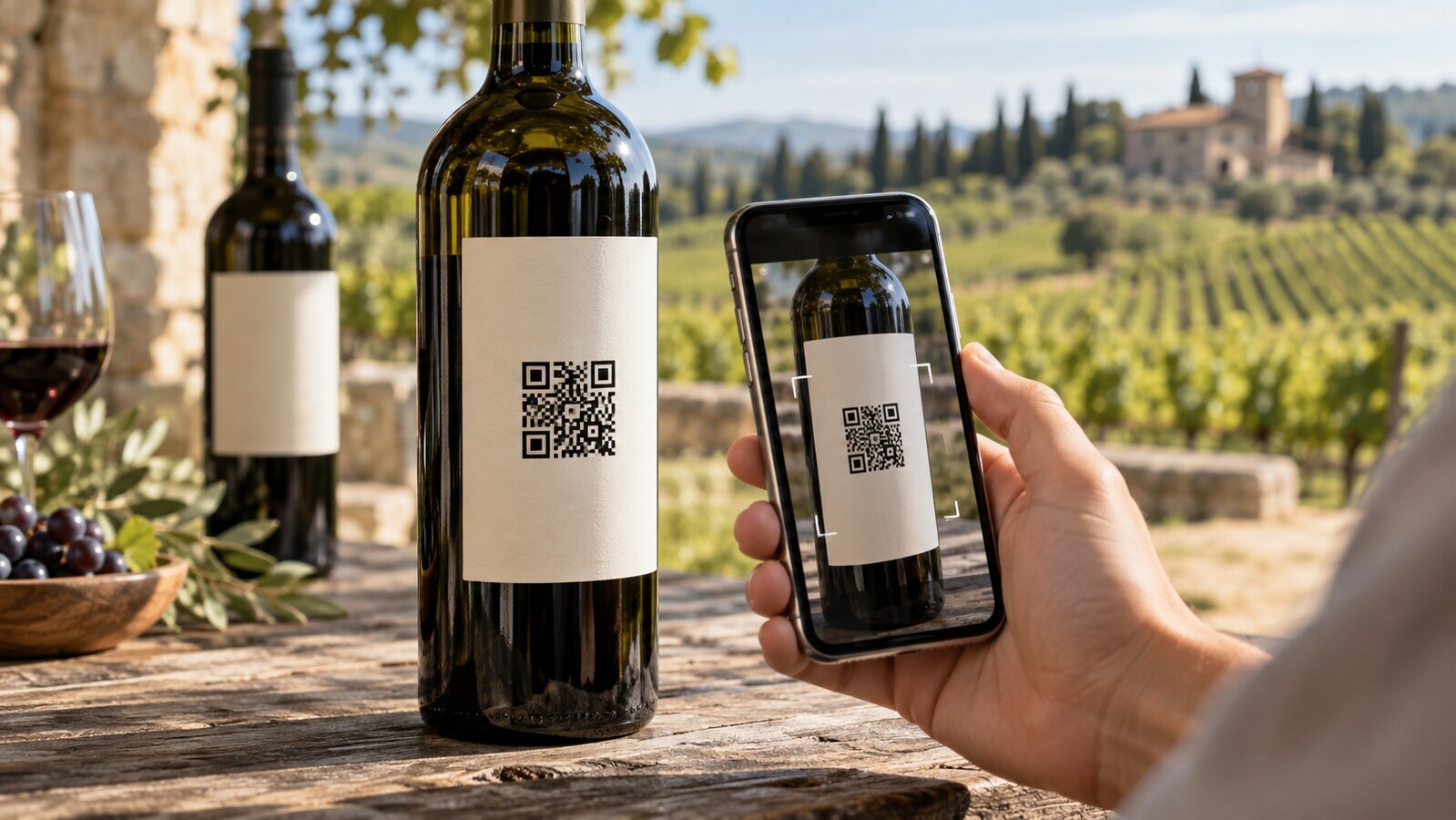
Small front and back labels are a constant headache once you add ingredients and nutrition information to the list of things a wine label is supposed to say. The good news: EU law does not ask you to fit everything on the glass. Under Article 119 of Regulation (EU) No 1308/2013, the full ingredient list and the full nutrition declaration can be provided electronically, which means your printed label only needs to carry a smaller, fixed set of particulars plus a link or QR code to the rest.
This article sets out, in practical terms, what stays on the bottle and what can move to the electronic page, and where EU-Label fits into that workflow.
What Article 119 treats as compulsory particulars
Article 119 of Regulation 1308/2013 lists the compulsory particulars for wine labelling. Among them are the nutrition declaration and the list of ingredients, alongside the other long-standing requirements such as the category of product, the actual alcoholic strength, the indication of provenance, the bottler's details and the lot number.
For de-alcoholised grapevine products below 10% actual alcohol by volume, a date of minimum durability is also part of the compulsory particulars.
Not every one of these can be pushed to an electronic page. Article 119(4)-(5) is specific about which two particulars benefit from the electronic option:
- the nutrition declaration, și
- the list of ingredients.
Everything else on the compulsory list stays printed in the normal way, on the package or an attached label.
What can move to the e-label
When a producer chooses to provide the nutrition declaration electronically, the physical label can limit itself to the valoare energetică instead of the full declaration. The complete breakdown (energy, fat, carbohydrates, sugars, protein, salt) then lives on the electronic page reached via the QR code or other electronic means identified on the package.
The same logic applies to the ingredient list: it can be provided electronically in full, as confirmed by Commission Delegated Regulation (EU) 2023/1606, which clarifies that the ingredient rules apply whether the list is printed on the label or supplied electronically under Article 119(5).
So, in practice, a printed label can be reduced to:
- the compulsory particulars that are not eligible for electronic provision (category, strength, provenance, bottler, lot number, and so on),
- the energy value, standing in for the full nutrition declaration,
- allergen information (see below),
- the QR code or link to the electronic page.
What must never leave the bottle
Two things do not move, regardless of how you set up your e-label.
Allergen and intolerance information. Article 119(4) is explicit that allergen particulars required under the food-information rules (Regulation (EU) No 1169/2011) must remain directly on the package or an attached label. The electronic page is not a substitute for this. If the wine contains sulphites or other listed allergens, that declaration stays printed, in full view, next to the other physical particulars.
Marketing content on the mandatory disclosure page. This is less about what stays on the bottle and more about what the electronic page is not allowed to become. Article 119 is clear that the electronic ingredient list and nutrition declaration must not be displayed together with information intended for sales or marketing purposes, and that user data must not be collected or tracked on that page. If you want a marketing-rich page for your wine, that is a separate page, not the mandatory disclosure one.
A practical checklist before you print
When you are laying out a new label or revising an old one, it helps to sort the information into three buckets:
- Must print, no electronic option – category of product, actual alcoholic strength, provenance, bottler details, lot number, and (where applicable) the date of minimum durability for de-alcoholised products below 10% ABV.
- Can print in short form, full version electronic – nutrition declaration (energy value stays printed; the rest can move), ingredient list (can move in full, subject to the conditions above).
- Must print in full, cannot move – allergen and intolerance declarations.
Getting this split right at the design stage saves a reprint later. It also means your printer or label agency only needs to leave space for a smaller, fixed block of text plus the QR code, rather than trying to squeeze a full nutrition table onto a narrow back label.
Unde se încadrează EU-Label
EU-Label is built around this exact split. The platform lets you set up the electronic page that carries the full ingredient list and nutrition declaration, generate a QR code that follows the GS1 Digital Link standard, and keep that page free of sales or marketing content and free of user tracking, in line with what Article 119 requires for that specific disclosure.
What EU-Label does not do is decide your printed layout for you or guarantee that your specific label meets every applicable rule. The legal requirement is yours to confirm for your product and market. What the platform provides is the technical side: a product page per wine, reusable data so you are not retyping ingredients for every vintage, and an account where you manage all your e-labels in one place.
Pricing is per new label created during the subscription year, from €4.00 down to €1.50 per label depending on volume, prices final with no VAT added. Scans are unlimited and edits to existing labels are free, so updating the ingredient list for a new bottling does not mean a new charge.
Pasul următor
If you are reworking a label layout and trying to work out what still needs to fit on the bottle, create your first e-label on EU-Label and see how the printed side and the electronic page split out. Questions about a specific case are welcome at contact@eu-label.info.



 RO
 EN
 FR
 IT
 ES
 DE
 HU
 SK
 CS