07 Oct
The short answer
If you put the full nutrition declaration on an e-label, the physical label still has to show one thing: the energy value. You cannot move everything online and leave the bottle with no nutrition information at all.
This comes up constantly in planning conversations, because producers assume the QR code replaces nutrition labelling entirely. It replaces most of it, but not the energy figure.
What Article 119 actually says
Article 119 of Regulation (EU) No 1308/2013, as amended by Regulation (EU) 2021/2117, allows the full nutrition declaration to be provided by electronic means identified on the package or attached label. That is the legal basis for e-labels and QR codes in wine.
But the same provision sets a condition: where the full nutrition declaration is supplied electronically, the physical package or label may limit the nutrition information to the energy value. That wording matters. It is not "nutrition information is optional on the bottle", it is "the bottle may show energy value only, instead of the complete breakdown."
So the practical split looks like this:
- On the bottle: energy value (typically expressed as kJ/kcal per 100 ml), plus all the other compulsory particulars under Article 119 that are not covered by the electronic-provision rules.
- On the e-label (QR code): the full nutrition declaration, meaning energy value plus the other nutrient values normally required under the food-information framework.
Why this exists
The reasoning behind the rule is space. Wine labels are small, and a full nutrition table does not fit comfortably alongside the name, vintage, appellation, allergen statement and everything else a label has to carry. Letting producers push the detailed table online, while keeping one reference figure on the bottle, is the compromise written into the regulation.
What else has to stay off the e-label
The electronic nutrition declaration is not a free page for anything you want to publish. Regulation 1308/2013 is specific about two restrictions that apply whether you are dealing with the ingredient list or the nutrition declaration:
- The electronic information must not be displayed together with sales or marketing content.
- No user data may be collected or tracked for that part of the page.
This means the nutrition and ingredient section of your e-label needs to be kept distinct from tasting notes, awards, shop links, or any promotional material. It does not mean your e-label as a whole can never carry marketing content, but the mandatory disclosure area itself has to stay clean, and it cannot be used to collect visitor data.
Allergen information is a separate matter again: required allergen and intolerance particulars stay on the physical package or attached label even when the ingredient list is provided electronically. The e-label does not replace that obligation.
A quick example of what a label might carry
A typical still wine label, once the full nutrition declaration moves to the e-label, might show:
- Product name, vintage, and other compulsory wine particulars.
- Allergen statement (for example, sulphites), directly on the label.
- Energy value, printed on the label.
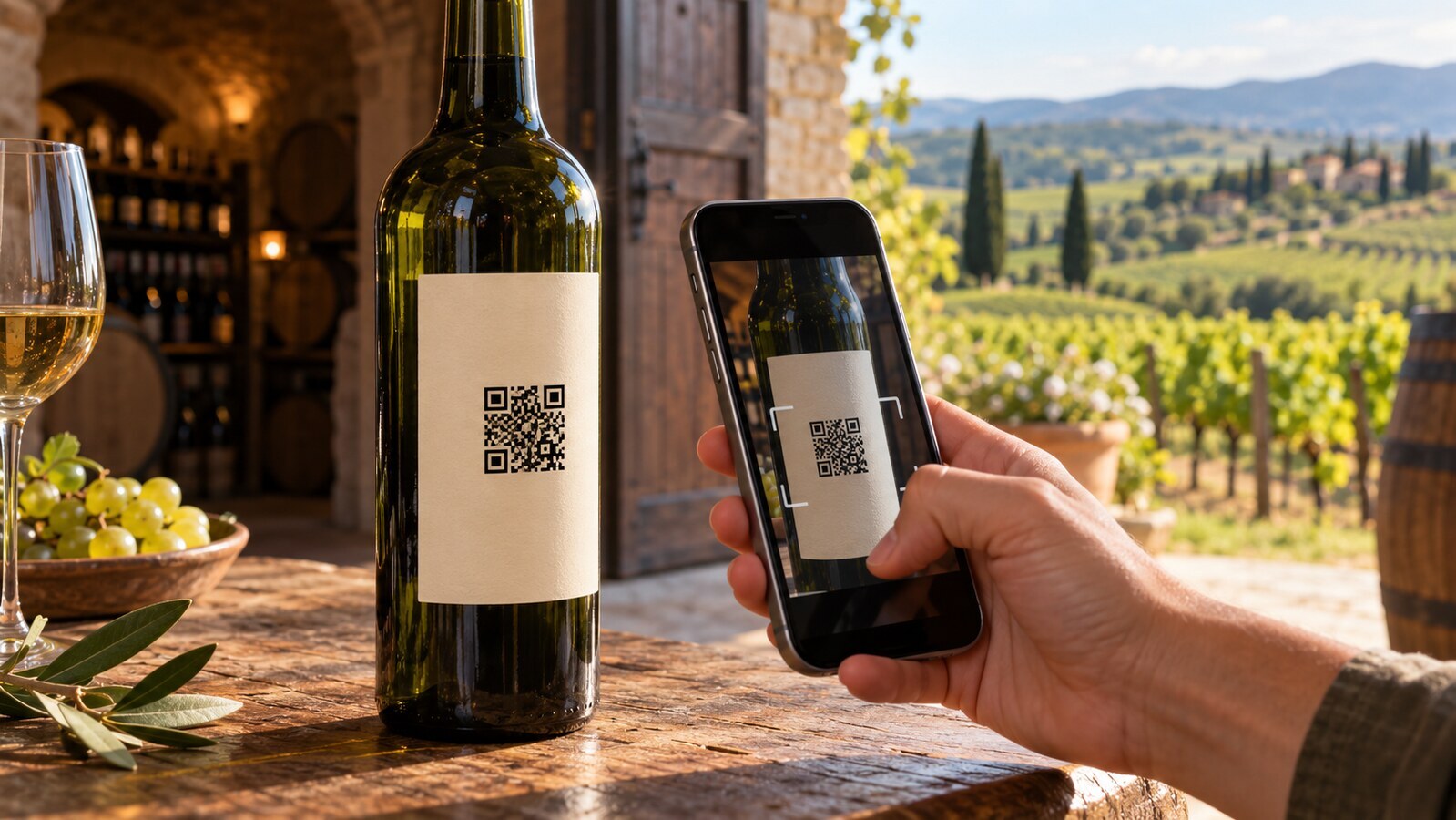
- A QR code or web address pointing to the e-label page.
The e-label page itself then carries the ingredient list and the full nutrition table (energy, fat, saturates, carbohydrate, sugars, protein, salt, and so on, per the applicable food-information rules), without marketing material mixed into that section.
Where EU-Label fits in
EU-Label gives each product its own web page, reachable through a QR code generated to the GS1 Digital Link standard. The ingredient list and full nutrition declaration go on that page, kept in their own section, with no cookies and no tracking on the mandatory disclosure part of the e-label, in line with the legal restriction on user data.
What EU-Label does not do is decide what goes on your physical bottle. That is your call, made with your printer or label designer, based on what your product needs: the energy value, the allergen statement, and whatever other compulsory particulars apply to your wine. EU-Label's job is the electronic side: storing the data once, letting you reuse it across vintages, and generating the page and QR code that the label points to.
This is also why it is worth treating the printed label and the e-label as two separate design jobs that have to agree with each other. Get the energy value onto the printed label, get the rest of the nutrition table and the ingredient list onto the e-label page, and make sure the QR code on the final print run actually points to the finished page before the bottles ship.
A note on wines bottled before December 2023
Wine produced before 8 December 2023 falls under a transition rule and may continue to be marketed under the previous labelling requirements until stocks are exhausted. If you are clearing older vintages alongside newly labelled ones, it is worth keeping track of which stock falls under which rule so your printed labels and any e-label pages stay consistent with the right vintage.
Where to start
If you are updating labels for a new vintage and need to work out what goes on the bottle versus what goes on the e-label page, create your first product page on EU-Label and see how the data splits across the two. If you have a specific labelling question for your product, write to contact@eu-label.info.



 EN
 RO
 FR
 IT
 ES
 DE
 HU
 SK
 CS