21 Oct
The short answer
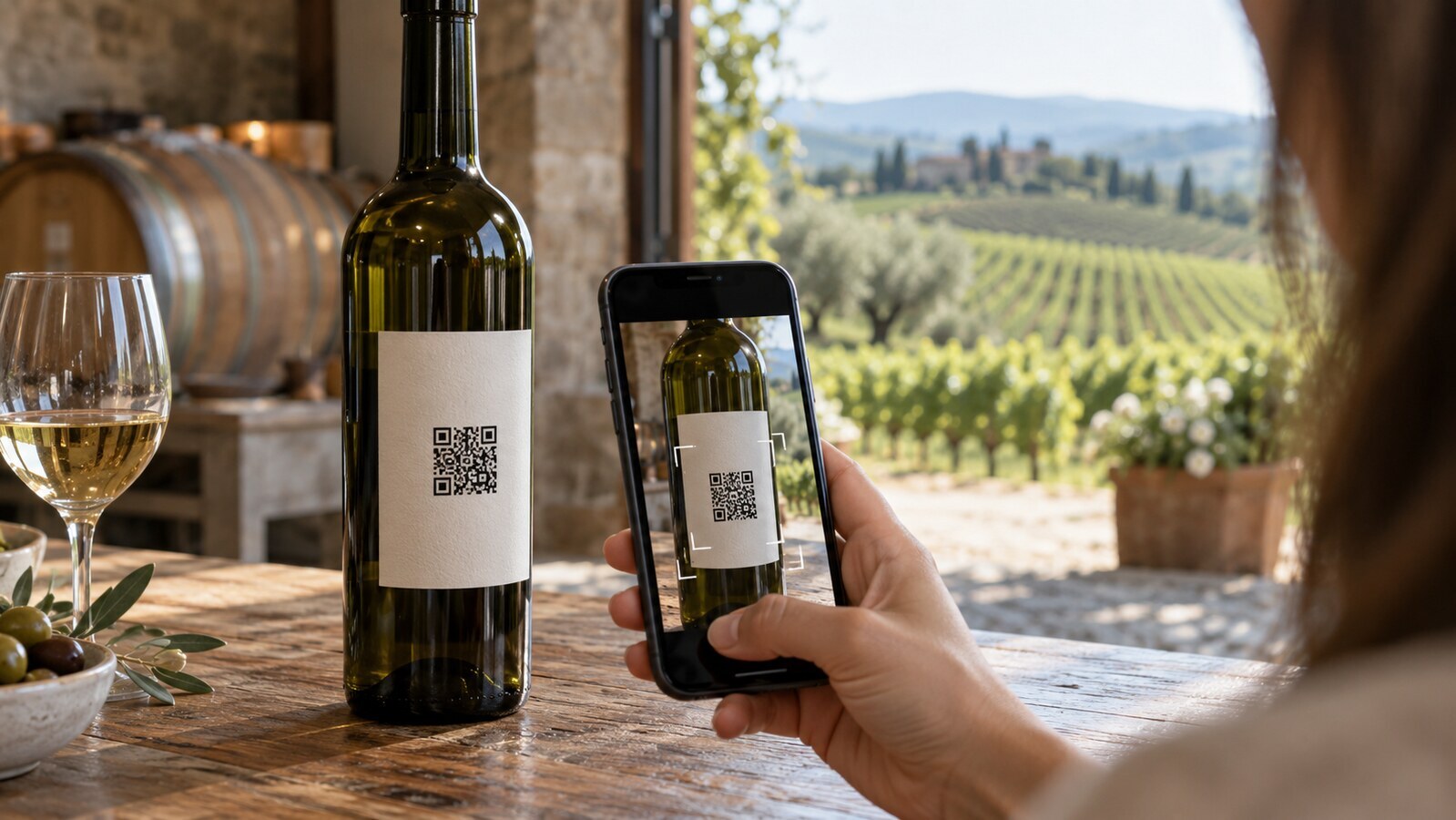
The page behind your wine's QR code can show the ingredient list and the full nutrition declaration. It cannot show sales or marketing information, and it cannot track the person who scans it. That's the rule, stated plainly in Article 119 of Regulation (EU) No 1308/2013, as amended by Regulation (EU) 2021/2117.
It sounds restrictive, but once you know the boundary, building the page is straightforward. The hard part is usually knowing where "product information" ends and "marketing" begins.
What the law actually says
Article 119(4)-(5) of Regulation 1308/2013 allows producers to provide the full nutrition declaration and the ingredient list electronically, instead of printing everything on the bottle. Two conditions come with that option:
- The electronic ingredient list and nutrition declaration must not be displayed together with information intended for sales or marketing purposes.
- User data must not be collected or tracked when someone accesses that electronic information.
Commission Delegated Regulation (EU) 2023/1606, which amended Delegated Regulation (EU) 2019/33, confirms that these ingredient rules apply whether the list sits on the printed label or is provided electronically under Article 119(5). So the electronic route is not a loophole or a lighter version of the rule. It's the same obligation, delivered a different way, with its own conditions attached.
Where the line sits in practice
It helps to split a wine's online presence into two separate things.
The mandatory e-label area:
- Ingredient list
- Full nutrition declaration (energy, fat, carbohydrates, etc.)
- Nothing else that promotes, upsells, or persuades
Everything else (your website, a catalog page, social media):
- Tasting notes
- Awards and scores
- Food pairing suggestions
- Brand story
- Links to buy
The regulation doesn't stop you from having marketing content about your wine online. It stops you from mixing it into the same page or screen as the mandatory nutrition and ingredient disclosure. A producer can absolutely have a beautiful website with tasting notes and photography. That website just can't be the same page the QR code's mandatory information sits on, with marketing woven in around it.
Why tracking is the other half of this rule
The no-tracking condition is separate from the no-marketing condition, but they usually travel together. A page built to track scans, collect emails, or build a marketing funnel is, by nature, built around a different purpose than plain regulatory disclosure. Keeping the mandatory information page free of analytics that identify individual users, cookies, and sign-up prompts keeps both conditions satisfied at once.
Note that allergen information is not part of this electronic option. Allergen and intolerance particulars required under the food-information rules (Regulation (EU) No 1169/2011) must stay directly on the package or attached physical label, regardless of what you put online.
What this means for how you design the page
A few practical consequences follow from the rule:
- No "buy now" buttons on the ingredient/nutrition page itself.
- No embedded reviews, scores, or awards on that same screen.
- No email capture forms or cookie banners tied to that page.
- No visitor tracking (no personal identifiers, no behavioural profiling) for that specific disclosure.
- A clean separation between the mandatory page and any marketing page you link to from elsewhere.
If you want to link from the e-label page to your website for people who want more, that's a design choice to make carefully. The safest approach is to keep the mandatory page self-contained and let visitors navigate away if they choose, rather than layering promotional content onto the same screen.
What EU-Label provides
EU-Label generates a dedicated web page for each product, built to carry the ingredient list and nutrition declaration without mixing in sales content on that page. The platform's position is privacy-conscious by design: no cookies, and no collection of personal information, on the e-label pages themselves. Analytics are limited to non-personal signals, such as which product was scanned, country, browser, and device model, not individual user tracking.
Separately, EU-Label also offers catalog pages, where you can select several products from your account and publish one shared page listing them together. That's a commercial, portfolio-style feature, useful for sharing a product range with a buyer or an importer. It is intentionally a different kind of page from the mandatory ingredient/nutrition disclosure, and the two should be kept apart in how you use them.
QR codes generated through EU-Label follow the GS1 Digital Link standard, and all plans include unlimited scans and free edits to existing label content, so updating the ingredient list or nutrition figures later doesn't mean reprinting anything.
This article explains what the regulation requires. Whether a specific page design, wording, or feature meets that requirement for your product and market is something to check with your own legal advisor, EU-Label provides the technical structure, not a legal sign-off.
Getting started
If you're setting up e-labels for the first time, or reviewing pages you already built before this rule was clear to you, start by checking what sits on the same screen as your ingredient list and nutrition figures. Strip out anything that reads as promotion, and make sure nothing on that page is tracking the visitor.
You can create your first product page and QR code at eu-label.info, or send a question to contact@eu-label.info if you're not sure how a specific page should be structured.



 EN
 RO
 FR
 IT
 ES
 DE
 HU
 SK
 CS